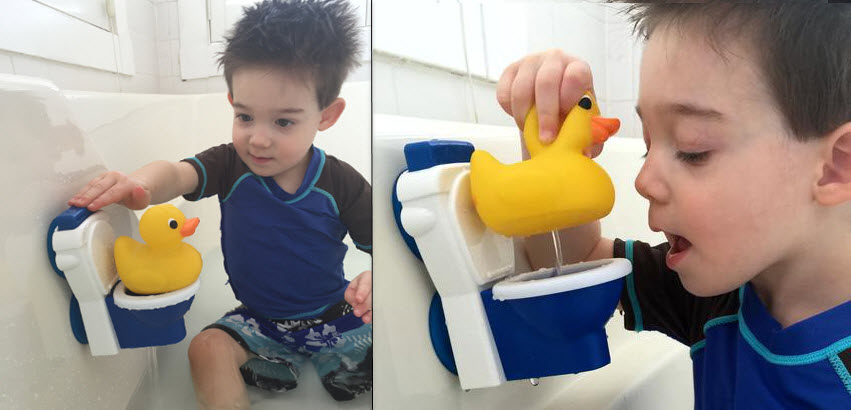
If you’ve spent any time on my website, you’ll know I very rarely review products. My work is firmly grounded in research, clinical experience, and child development, not in promoting gadgets. But every now and then, something crosses my path that genuinely aligns with the evidence in a meaningful way.
Potty Duck is one of those things.
And that makes it worth talking about.
This post isn’t sponsored, and I don’t have any financial relationship with the company. I simply think it’s a clever, thoughtful idea with real potential, so long as you use it within a wider framework of play-based, child-centred learning.
Potty duck can be used as part of my 3-Step Potty Training Method, which is grounded in developmental science and designed to make potty learning gentle, successful, and fun.
How Potty Duck Aligns With Child Development Research
Potty Duck was designed by two friends, Fred Longenecker and an experienced pediatrician, and it wasn’t created as a gimmick. The whole concept began with his own daughter experimenting in the bath, using imitation, curiosity, and sensory play (exactly the ingredients of effective early learning!). From that moment grew a toy intentionally designed around some of the strongest principles we have in child development research, including:
- Modelling and observation (Bandura, Vygotsky)
- Sensorimotor exploration and pretend play (Piaget)
- Social learning, emotional mirroring, and paraverbal communication (Trevarthen, Ishikawa & Itakura)
- Learning through repetition, rhythm, sound and embodied experience
These pillars appear throughout the academic literature and they also underpin my 3-Step Method. So, while I don’t normally write about products, I was genuinely impressed to see a toy intentionally built around the very research I spend my days teaching and applying.
But it’s plastic, Rebecca!
Yes, Potty Duck is plastic. And while I usually steer families toward eco-friendly, reusable materials, in this case I will concede that the plastic has a practical purpose. A squeezable, water-flow toy simply wouldn’t work in wood or fabric, and this is a durable item designed to be used again and again, not a disposable gimmick. Would I love to see a recycled or bio-based version one day? Absolutely. For now, I’ll leave it to you to decide how to pick your battles.
Where Potty Duck Fits Into My 3-Step Potty Training Method
Step 1: Preparation (Body Awareness & Understanding the Process)
This is where Potty Duck shines.
In Step 1, we build the foundations long before a child is expected to “perform.” Children learn what the potty is for, where the wee and poo go, and how their own bodies feel before, during, and after.
Potty Duck can help your child to:
- See what happens (children love visual cause-and-effect)
- Hear the “psssshhh” sound and associate it with weeing
- Feel the squeeze-release action as a stand-in for bladder contraction
- Explore the ritual (sit, wee, flush)
- Practise in a playful, zero-pressure environment
This matches well with the sensory, modelling, and imitation principles my method is built on.
In our house, my daughter absolutely loved making her duck sit, wee, and flush. She gave the duck a little pep talk, narrated the whole thing, then proudly flushed the water away. This is exactly the sort of early play I encourage.
Step 2: Practice
Once children have basic awareness, Step 2 focuses on guided practice, gentle prompting, and building confidence (without pressure).
Here, Potty Duck can act as a:
- Social “buddy” for children who are hesitant
- Demonstration tool when explaining steps
- Safe intermediary for children who fear the toilet
- Shared attention anchor that helps parents stay playful
However, its important to understand that no toy can completely replace rich, imaginative, adult-led guidance. This is where activities like:
- Mr Poo and Poo Doh
- The balloon water game and Mrs Wee
- Doll play
- Storytelling
- Bathroom modelling
- Routine-building games
…are needed to create a complete learning package.
Open-ended play allows the child to internalise the learning, not just imitate it.
So in Step 2, I view Potty Duck as a lovely adjunct to potty learning.
Step 3: Independence from nappies (Mastery & Routine)
By Step 3, children are consolidating the skill. Potty Duck here becomes less central, but still useful as:
- A comfort item
- A reminder of the steps
- A motivator on tricky days
- A playful companion during bathroom routines
Some children enjoy “teaching the duck” what to do, which reinforces their own mastery (a great sign neurologically that the learning is embedding).
The bottom line on Potty Duck
I want to be kind but honest: Potty Duck is wonderful, but it’s not a complete method. And to be fair to Fred, he doesn’t claim it is.
Potty Duck works best when woven into a broader, evidence-based approach—one that includes:
- adult-guided modelling
- emotional safety
- sensory-motor play
- rituals and routines
- language exposure
- body awareness
- imagination and humour
- recognising signs of capability
- supporting temperament
- promoting bowel and bladder health
Potty Duck is an excellent example of what can happen when good ideas meet good science. Fred followed his child’s lead, observed something meaningful, and turned it into a resource that aligns remarkably well with the research evidence and the fundamentals of my 3-Step Method.
It’s fun.
It’s thoughtful.
It’s evidence-supported.
And children genuinely enjoy it.
Just remember: The real magic isn’t in the duck. It’s in the relationship, the play, the modelling, the connection and the method you use alongside it.
Potty Duck is currently seeking a new owner or publisher, as well as a toilet training research team to formally study its impact. Longenecker has written a children’s board book manuscript to accompany Potty Duck. Email Fred here: contactus@pottyduck.com