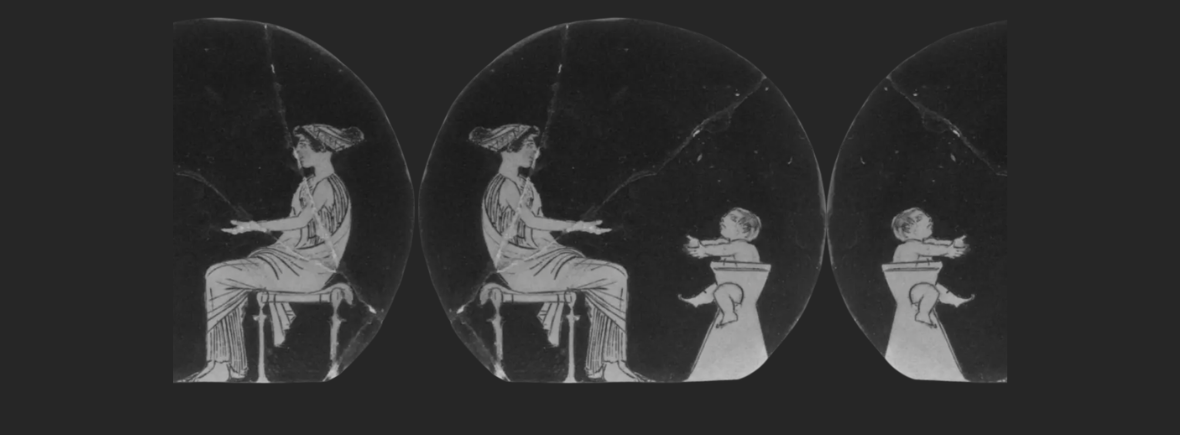
For thousands of years of human history, babies began to learn toileting skills from birth and typically reached toilet independence by the age of 12 months. So what changed? How did we get to 2026 where many parents haven’t even started to potty train until the age of 3 and with 1 in 4 children now starting school aged 4 or 5 without being full potty trained? Nurse Rebecca Mottram shares what we can learn from the history of toileting.
The history of toileting
We know a surprising amount about toileting in ancient cultures, despite there being fewer written records.
600 BCE
The oldest potty found by archaeologists dates back to the 6th Century BCE and can be found in the Ancient Agora Museum in Athens1. Called an Ouretin, it even includes an instruction for use – an illustration showing the parent connecting with their child whilst they use it. The ancient Greeks and Romans would keep a sea sponge on a stick in a container of salt water for wiping.


480 BCE
The oldest evidence we have of Baby Pottying, we learn from Euripedes2 whose plays describe Spargana – a method of swaddling an infant’s individual arms and limbs for the first 40-60 days of birth, leaving a strategically placed gap for toileting so the outer layer could be quickly removed for babies to be held out to wee and poo. This is also demonstrated by these icons from this time revealing an opening for the buttocks.

Toilet learning for infants would have been a visible part of everyday life. People lived and slept mostly in one room houses without any private toilet facilities so weeing and pooing in front of your family or seeing people from your community squat in the street to relieve themselves was the norm.
100 BCE
Infant toileting looked different among cultures where babywearing was common. In hotter climates such as Africa and Egypt, fabric wraps would enable the parent to feel an infant’s abdomen contract or notice their fussing and allow them to be unwrapped and held out to toilet.
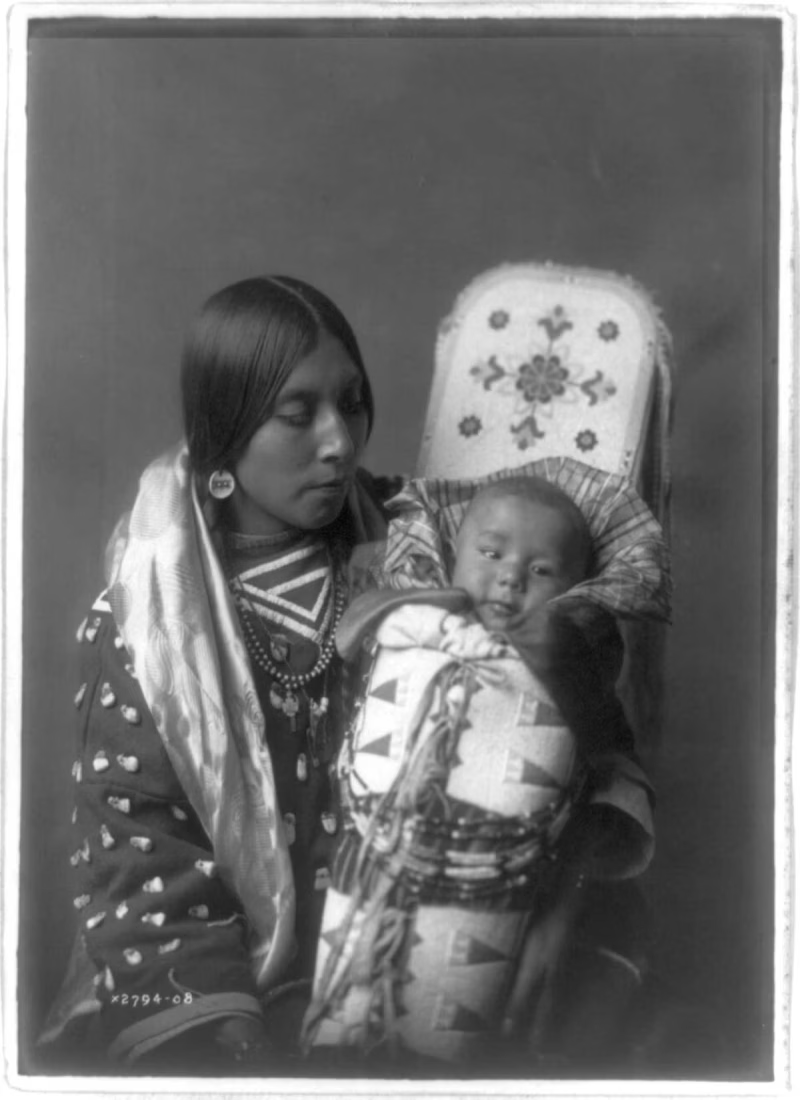
For Native American people, the use of Cradleboard3 carriers when travelling were more like nappies. Lined with natural plant fibres like moss, bark, down, or juniper – these could be replaced when soiled. The antiseptic properties of the plants chosen would have been protective for baby’s skin.
1500-1900
In the 1500s there were 3 ranks of toilet – the royals would use a close stool and wipe with linen cloths which were then boiled for re-use, courtiers would use chamber pots and everyone else used Common Jakes – community toilets which could seat up to 13 people with straw to wipe.

Up until the 18th Century, shared toileting was so normalised that London even had an 84 seat public toilet in Greenwich Street!
Whilst infants continued to use potty chairs and chamber pots, the societal approach to toileting was about to slowly shift from public to private.


The first indoor flushing toilet (called the Ajax4) was designed by Sir John Harrington and first ordered by Queen Elizabeth 1 in 1596. Modern plumbing would not be able to support the widespread adoption of flushing toilets however for a few hundred years more. In 1848 the government declared that every house should have its own ash-pit privy or water closet5 – leading to The Great Stink in 1858. Thomas Crapper6 designed a flushing toilet for Prince Edward in 1861 and by 1865, suitable sewer systems in London were completed. The first disposable toilet paper arrived in the UK in 1880.7
Despite these changes, potty learning for infants began at birth and concluded between the ages of 12 and 18 months.
So when was it that attitudes towards infant toileting changed?
1940s – 1960s
The first prototype of the modern disposable nappy was a nappy cover called the Boater8, invented from a shower curtain and some parachute cloth by Marion Donovan. At first, parents didn’t see any sense in wrapping their baby in plastic. Disposable nappies were expensive and unpopular right through the 1950s when Proctor and Gamble began to sell them, finally reaching small success with the mass market under the brand of Pampers by 1966.

In 1962, a Paediatrician called Dr T. Berry Brazelton began to promote a “child-oriented” toilet training approach9 through the journal Paediatrics. He claimed that parents should delay teaching any toileting skills until children showed signs of “readiness” and suggested this would typically happen around the age of 2, long after the age at which children are developmentally capable of having completed the process!
1980s – 1990s
Procter & Gamble realised that delayed toileting would mean that parents were buying nappies for longer. To help parents gain trust in their Pampers products, P&G hired Dr T. Berry Brazelton, funding his foundation in 1996 (he remained the chairman until his death in 2018) and featuring him in adverts for the introduction of their new larger sized, pull-up nappies called “Easy Ups” in 1998. (Today, Pampers go up to a size 9 and also offer disposable pyjamas which fit up to the age of 12. My video on Night Time Potty Learning goes into more detail about the impact of disposable nappies on night time dryness.)
Brazelton’s readiness-based approach became highly influential, and its later use in disposable nappy marketing aligned with commercial incentives to prolong nappy use. So why did this dramatically increase the age at which children reached independence? What lead to a decrease in bladder and bowel health, a rise in withholding, constipation, and emotional and behavioural issues around toileting?
The science of potty learning
From the day that a child is born, their brain signals to them that their bladder or bowels have reached capacity. Over time, they learn to connect this feeling with the act of using the potty or toilet if they are given the opportunity to use it. There are over 40 skills to master before they can manage this process independently, but they are developmentally capable of many of them within the first 6-9 months of life.10
This developmental arc is similar to walking – at first an infant needs to be carried, but then they are capable of holding up their own head, crawling and usually walking independently within the first year of life.

(You can download your own copy of my potty skills grid for free)
Disposable nappies are designed to wick away moisture, feeling instantly dry. As a result, they are a highly effective containment product, but the flip side is that they also disconnect the child from their bodily functions.
There are 3 stages to reaching toilet independence:
1. Awareness (realising what happens and when),
2. Responding (getting the pee and poo in the right place) and
3. Independence (learning how to do 1 and 2 on your own).
Whilst wearing a disposable nappy, babies quickly learn to ignore the signal for wee and if they do notice they have done a poo, they learn over time that the socially acceptable place for this to happen is in their nappy and that their parent or caregiver is responsible for responding to it.
When one day, their parent or caregiver finally decides their child is “ready” to begin learning, the child is now expected to activate this long dormant facility and learn all 40 skills at once – often over 2 or 3 days, especially if they have a working parent and need to master the process quickly before they go back into childcare. This is a very different experience from a child learning gently and gradually from birth – a natural arc of development which matches every other independence skill like eating, walking and talking.
Why does the “readiness myth” endure?
Often, when potty training problem arise, parents are advised that the child ‘isn’t ready’, rather than considering instead that they have not had the opportunity to develop skills in this area that would help them be capable of success. This is why preparation is so important.
The readiness message also has a commercial consequence: the longer children remain in nappies, the longer families keep buying disposable products. Unless parents actively prepare them to move on from nappies, children are never going to seem “ready” to do so. The idea that children must simply be left until they become ‘ready’ is misleading, because many toileting skills can be taught and practised long before nappies are removed.
Of course not all disposable nappy manufacturers are so irresponsible. For example Pura platform child-centred attitudes towards toileting rather than perpetuate the readiness myth.
Nurse Rebecca Mottram – a global expert in potty learning
I am a children’s research nurse and globally recognised potty learning expert.
I have spent over 10 years advocating for parents to introduce the potty in early infancy in order to prevent the harm which can be caused by using nappies. The convenience of nappies makes them a necessary part of modern parenting, but by offering the potty even just once or twice a day, children have the opportunity to learn necessary toileting skills in a developmentally appropriate way.
During my time working with ERIC – The Children’s Bowel & Bladder Charity, I wrote new guidelines for potty learning which are now supported by The Institute of Health Visiting (iHV), Department for Education (DfE) and the Office for Health Improvement and Disparities (OHID).
Parents deserve to understand the options available to them and what the impact of those choices are so they can make informed decisions about how to manage their children’s toileting needs.

Nurse Rebecca Mottram is an advocate for Baby Pottying and a potty training expert. She is the author of two books; The Baby Pottying Guide and Positively Potty, the host of the Go Potty Podcast and founder of the Little Bunny Bear shop. If you are trying to resolve a potty problem, you can explore Rebecca’s free resources, join her Facebook group or request a private consultation.
References
1 Sella Cacatoria (2006). Kathleen M. Lynch and John K. Papadopoulos
2 Babesch Supplements: Annual Papers on Mediterranean Archaeology (2011). Gemma C. M. Jansen
3 Swaddling, cradleboards and the development of children (1978). J S Chisholm
4 Oxford Dictionary of National Biography (Oxford University Press, 2004) Jason Scott-Warren
5 The Sanitary Act (1868)
6 Thomas Crapper & Co (1861).
7 The British Patent Perforated Paper Company Limited (1880).
8 U.S. Patent 2,556,800 (1951). Marion Donovan’s “Diaper Wrap”
9 Brazelton, T. B. (1962). A child-oriented approach to toilet training. Pediatrics, 29(1), 121–128. DOI: 10.1542/peds.29.1.121. PubMed PMID: 13872676
10 The Evidence Behind the Go Potty 3-Step method. (2022). Nurse Rebecca Mottram